

Turkey treats more international dental patients than any other country in Europe. The numbers have been climbing for over a decade and the reasons behind that growth have not changed: the cost is substantially lower than at home, the quality at established clinics is genuinely high, and the logistics of combining treatment with a short trip have become well-practised at both ends. Patients from the UK, Germany, the Netherlands, France, and Scandinavia now travel to Turkey for dental work the way previous generations travelled for elective surgery. It has become, for many, the obvious and unsurprising choice.
Contents
ToggleThis guide covers what you actually need to know before you go. Not the promotional version. The honest one.
Why Turkey Became Europe's Go-To for Dental Treatment
The price difference is structural. Running a dental clinic in Antalya or Istanbul costs considerably less than running one in London, Amsterdam, or Frankfurt. Labour costs, property, utilities, all of it sits at a fraction of the Western European equivalent. The materials inside that clinic, the implant brands, the ceramic systems, the digital scanning equipment, came from the same manufacturers. The dentist who treats you trained for five years and in many cases completed postgraduate specialisation on top of that.
What patients are paying less for is not the clinical quality. It is the overhead that surrounds it. That structural difference produces a price gap that is not marginal. For most treatments, patients save between 60 and 75 percent compared to equivalent private care at home. That is the figure that makes the flight worthwhile.
Something else has happened alongside the price advantage that tends to go unmentioned. The clinics in Antalya and Istanbul that have been handling international patients for years have built a process specifically around the constraints of people flying in for a week. The coordinator who contacts you speaks your language. The hotel is sorted. The car is at the airport. The appointments are sequenced so that travel days are not wasted. Patients who have dealt with waiting lists, GP referrals, and fragmented specialist appointments at home often remark that the Turkish experience felt more organised, not less. That is not an accident. It is the result of clinics having refined this particular type of patient journey over a long time.
What Treatments People Come to Turkey For
People come for different reasons but the treatments themselves cluster into a handful of categories that account for the vast majority of international patients.
Missing teeth bring the largest group. Someone who has been told an implant costs £2,500 at their local clinic and has put the decision off for two years looks at the Turkish price and makes the appointment. A single implant including the crown at an established clinic in Antalya sits between £500 and £900. The procedure is identical. The implant brand is often the same. The cost difference reflects the operating environment, not the clinical standard.
Aesthetic work accounts for the second largest group. Veneers, crowns, whitening, smile makeovers. People who want to change something about their smile but found the private cost at home difficult to justify find that the Turkish equivalent changes that calculation. E-max veneers cost between £150 and £250 per tooth in Turkey. The same material from a comparable clinic in the UK sits between £700 and £1,000. Across ten teeth, that is a difference that funds the flights, the hotel, and the treatment combined and still leaves change.
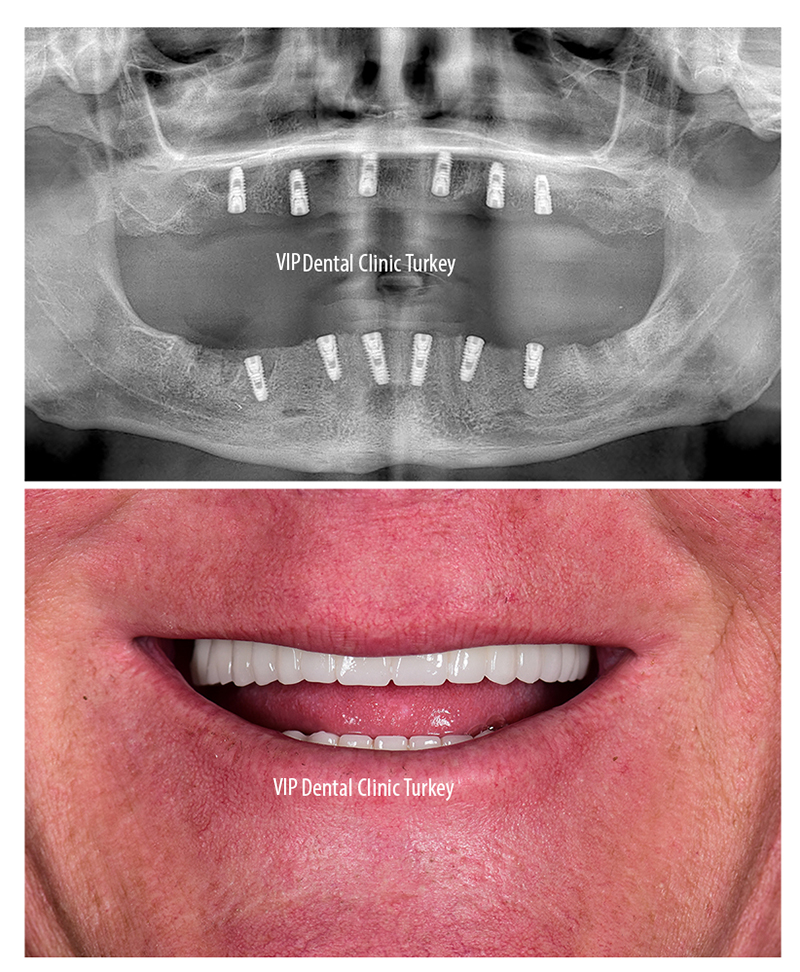
Full arch cases, All-on-4 and All-on-6, bring patients who have often been living with significant tooth loss for years. The cost of this treatment at home, typically £12,000 to £18,000 for a single arch, has kept it out of reach. In Turkey the same arch runs £3,500 to £5,500. For patients needing both arches, the Turkish total often costs less than a single arch would at home.
Smile makeover packages combining multiple treatments, veneers, crowns, whitening, gum contouring, are increasingly popular as a single trip covering a complete aesthetic transformation. These packages vary in scope and price depending on what is involved.
| Treatment | Turkey 2026 | UK | Germany |
|---|---|---|---|
| Single implant + crown | £500 – £900 | £2,000 – £3,000 | €1,800 – €2,800 |
| E-max veneer (per tooth) | £150 – £250 | £700 – £1,000 | €600 – €900 |
| Zirconium crown (per tooth) | £120 – £200 | £500 – £800 | €450 – €750 |
| All-on-4 single arch | £3,500 – £5,500 | £12,000 – £18,000 | €11,000 – €16,000 |
| Smile makeover (10 teeth) | £2,000 – £5,000 | £7,000 – £15,000 | €6,000 – €13,000 |
How to Choose the Right Clinic
The quality range is wide. At one end are well-run clinics with on-site labs, experienced clinical teams, and systems built around international patient needs. At the other end are operations that have entered the market to catch overflow demand and have made compromises on materials, lab quality, or time per patient. The marketing on either type of website often looks similar, which is why surface impressions are not a reliable guide.
What actually separates them comes down to a few specific things. Whether the clinic will share a preliminary treatment plan before taking a deposit. Whether they name the materials they use without being pressed. Whether the lab is on-site. Whether the aftercare process is described specifically or vaguely. These are the variables that predict the outcome far better than the photos on the homepage.
Accreditation and licensing are the baseline. Every legitimate clinic holds a Ministry of Health license and every practicing dentist is registered with the Turkish Dental Association. JCI accreditation indicates that an independent body has audited the clinic's operations. Not every good clinic holds JCI accreditation, but clinics that do have demonstrated a level of operational discipline worth noting.
Materials transparency is the most reliable signal of clinical quality. Ask the clinic which implant brand they use. Straumann, Nobel Biocare, Osstem. These are systems with documented long-term track records. Ask which ceramic system they use for veneers and crowns. A clinic that answers these questions specifically and without hesitation is one that is confident in what it is using. A clinic that gives vague answers or redirects to the price is telling you something.
Lab setup matters more than most patients realise. Clinics with on-site labs have direct control over quality and turnaround time. The ceramist working on your veneers is in the building. Adjustments happen quickly. Clinics that outsource lab work to cheaper external facilities have less control over either.
Patient reviews on independent platforms give a realistic picture of what previous patients actually experienced. Look for volume and recency. A clinic with fifty reviews over ten years is less informative than one with five hundred reviews in the last two years.
What the Process Looks Like Step by Step
Understanding the full sequence of a dental treatment trip to Turkey removes most of the uncertainty that stops people from booking.
Before you travel, the process begins with the remote consultation. You contact the clinic, share your dental photographs and any recent X-rays or scans you have. A dentist reviews your case and produces a preliminary treatment plan. This plan is discussed, adjusted if needed, and a quote is agreed. The clinic then confirms appointment dates, hotel, and transfer arrangements. Most clinics ask for four to six weeks notice for straightforward cases, more for complex implant treatments.
On arrival, you are met at the airport and transferred to your hotel. The first clinical appointment is typically the same day or the morning after. Full X-rays and photographs are taken, the treatment plan is confirmed against what the clinical assessment shows, and any adjustments are made and discussed with you.
During the treatment week, the main procedure takes place on day two or three. For veneer and crown cases, temporary restorations are placed while the lab produces the permanent pieces. For implant cases, the surgery happens and temporary teeth are fitted the same day in most cases. Recovery days follow, with lighter appointments for checks and adjustments. The permanent restorations are fitted toward the end of the week, fine adjustments are made, and you sign off on the result.
Before you fly home, ask for a complete clinical report. This document should specify every procedure performed, every material used, the dental implant price and model number if applicable, and any relevant dimensions or specifications. This report is what allows a dentist in your home country to continue your care without starting from scratch.
When you are home, a direct contact for aftercare questions is standard at clinics that take this seriously. The kinds of things that come up, mild sensitivity, a crown that feels high on one side, a veneer edge that catches slightly, can almost always be resolved remotely. A photograph sent via WhatsApp or email, a description of what you are noticing, and a response from the treating dentist is all that is required for most post-treatment questions. For anything that needs a physical appointment, the clinical report you brought home is what allows a local dentist to treat you without guesswork.
What to Prepare Before You Travel
Showing up with the right information makes the consultation faster and the treatment plan more accurate from the start.
Prepare before you contact any clinic
Recent X-rays help. A panoramic scan is ideal. If you do not have one, send clear photographs of your teeth taken in natural light from the front and from both sides. Most clinics will work from these and take a proper scan when you arrive. The remote consultation is more useful when the clinic has something clinical to look at rather than just a description.
Know what you want to change before you ask for a quote. A specific brief produces a specific plan. A vague one produces a generic price. Knowing whether you care more about aesthetics or durability, whether certain teeth matter more than others, whether you have a budget ceiling, all of this helps a clinic produce a preliminary plan that is actually relevant to your situation rather than a document that covers every possibility.
What to Watch Out For
Dental tourism in Turkey produces good outcomes for the patients who approach it well and poor ones for those who do not. The problems that appear in negative reviews follow recognisable patterns.
Choosing on price alone is the most reliable route to a disappointing result. The cheapest options in Turkey are not the same as the best options in Turkey, and the difference shows up in the materials, the lab, and the amount of clinical time the dentist actually spends. A quote that is dramatically lower than comparable providers should prompt the question of where that saving is coming from.
Booking before any clinical information has been reviewed is the second most common problem. A treatment plan produced before anyone has seen your X-rays is not a treatment plan. It is a price list.
Expecting things that are not clinically possible in the time available creates pressure toward clinics that make promises they should not. Veneers need lab time. Implants need months of osseointegration. A two-day timeline for a full smile makeover is a signal, not a convenience.
Leaving without a clinical report is the mistake that causes the most difficulty later. Every patient should leave Turkey with written documentation of every procedure, every material, and every specification relevant to the treatment received.
Frequently Asked Questions
How long does dental treatment in Turkey take?
Is the quality of dental treatment in Turkey comparable to the UK or Germany?
What happens if I need follow-up treatment after returning home?
Do I need travel insurance for dental treatment in Turkey?
Can I visit Turkey as a tourist while having dental treatment?
What should I do if I am unhappy with the result?
Request a Callback
We will call you back within 2 hours during clinic hours.