








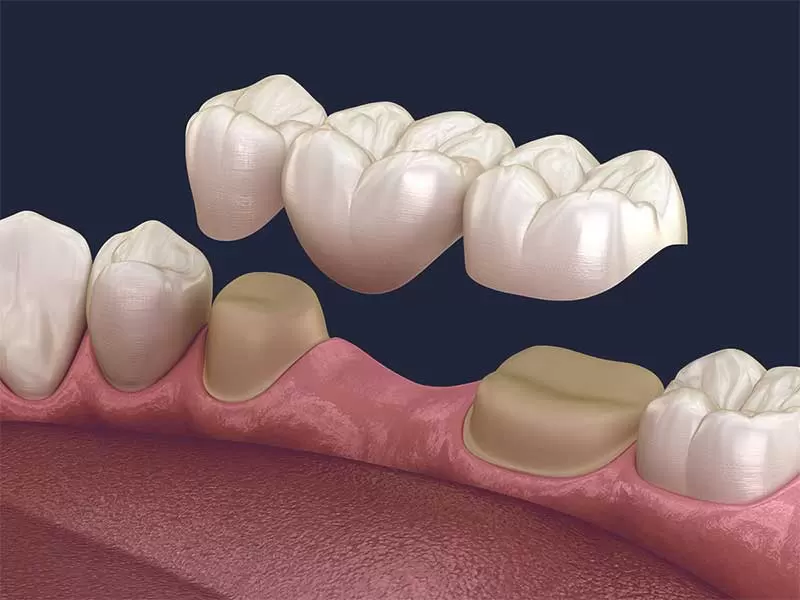
Dental bridges are one of the most popular treatment methods.
A dental bridge is used to correct the problems caused by tooth loss. The restoration provides a permanent replacement for missing teeth by taking support from the neighbouring teeth on either side of the gap and forming a bridge between them.
A dental bridge can successfully close large or small gaps between teeth. Different types of bridge can be used, depending on the materials and on how the restoration is attached to the supporting teeth. Bridges have been used for a very long time to treat missing teeth, and they can be made in a very short time.
What is a dental bridge?
A dental bridge is a fixed prosthetic dental treatment used to replace missing teeth in the mouth. Because at least one supporting tooth or implant is needed to fit a bridge, it cannot be used for patients with weak teeth. A bridge is fitted by a prosthodontist.
A bridge is made to restore the patient's lost function, appearance and speech. Prostheses can be made from many materials, but the most popular in terms of strength and durability are ceramic bridges with a metal substructure.
How is a dental bridge made?
A bridge is built by taking support from healthy teeth and closing the gaps left by the missing teeth. Depending on its type, a bridge can be fitted over one or more gaps. The key point in fitting a bridge is the need for healthy neighbouring teeth that can provide support on the right and left sides.
At the first examination with the dentist, the type of bridge is decided according to the missing tooth. Once this has been decided, the teeth on the right and left that will provide the support are prepared and slightly reduced. The purpose of this is to create enough space for the new tooth.
After the teeth are prepared, measurements are taken to make the bridge. When the supporting teeth are prepared, the sensitive layer of the tooth called dentine is exposed. Until the permanent bridge is fitted, a temporary bridge is placed to prevent sensitivity to cold and heat.
Once the measurements have been taken, the bridge is made in about 3 to 10 days. When the finished bridge reaches the dentist, it is tried in. Both the functional and aesthetic features are checked, such as how it fits with the other teeth in the mouth, its size, colour match and bite. If any problem is found, the dentist resolves it quickly and the bridge is then fitted.
Types of dental bridge
In clinical practice, bridges are made in four different ways. These are:
Conventional
Cantilever
Maryland
Implant-supported
The main aim of dental treatment is to preserve as much healthy tooth tissue as possible. For this reason, different types have been developed to protect the neighbouring teeth. Bridge alternatives are generally classified according to how they are attached to the adjacent supporting tooth.
For a conventional bridge, the healthy teeth next to the gap are ground down and reduced. There are also bridges that can be made without needing to cut the teeth. Different materials can be used in the restorations, such as ceramic, metal alloys and zirconia.
The conventional bridge
In this type of bridge there are crowns covering the teeth on either side of the gap, with a pontic that replaces the missing tooth between these crowns. The pontic is shaped like the missing tooth and is joined to the teeth on either side of the gap by the crowns.
In restorations of this kind, for the bridge to stay stable, the natural teeth next to the gap need to be slightly reduced. The greatest advantage of the conventional approach is the aesthetic appearance of the teeth and a firm hold. Restorations that are bonded to the abutment teeth do not come off easily.
The cantilever bridge
Cantilever bridges, also known as hanging bridges, are preferred when only one side of the gap has a firm tooth. The purpose of using them in dentistry is generally to spare the patient from having to use removable dentures.
The Maryland bridge
The winged bridge, also called the Maryland or adhesive bridge, is used especially to restore the front teeth. It is made as an artificial tooth to replace the missing teeth and is fixed to the back surfaces of the neighbouring teeth.
The back surfaces of the neighbouring teeth are lightly roughened with acid, and the prepared restoration is bonded to them with composite filling materials. In this way, bridges can be made without having to cut the healthy neighbouring teeth, which are important for dental health.
The retention of these bridges is much weaker than that of the others. For this reason, they are not used on the back teeth, where chewing forces are strong. The impressions are sent to the laboratory, and the ceramic teeth are made in the same colour as the neighbouring teeth.
The implant-supported bridge
This is the method used when there are no natural teeth in the jaw that can be used to support the bridge. In this method, the implants placed in the jawbone at the two ends of the missing-tooth area are joined to each other by a bridge. This makes it possible to replace a large number of missing teeth with far fewer implants, instead of placing one implant for each missing tooth.
How is a fixed porcelain bridge fitted?
Another name for what is known as the conventional dental bridge is the fixed porcelain bridge. There are several stages in fitting a fixed porcelain bridge:
The natural teeth to which the bridge will be attached are prepared.
An impression of the gums, the gap and the teeth is taken and sent to the laboratory.
A temporary bridge is fitted until the permanent bridge arrives.
When the permanent bridge is ready, the temporary bridge is removed and the dental bridge is fitted permanently.
Get a free quote:
If you would like detailed information about our dental treatments, you can contact us by filling in our consultation form, or you can get information directly on our WhatsApp line at +90 544 348 07 87. Our dentists will plan the most suitable treatment for you and give you detailed information.


